Thursday, March 13, 2008

CRCB Chapter 7 Using Inference to Identify Implied Main ideas


CRCB Chapter 7

Using Inference to Identify Implied Main Ideas
Summary

In order to fully understand a reading assignment, you need to read the material and combine what is stated with the additional information you generate using inference as tool. While inference is a skill you practice every day, inferring meaning from textbooks and other college reading material requires you to use specific strategies such as detecting an author’s bias, nothing comparisons, and recognizing information gaps.

CRCB Chapter 6 Using Inference to Identify Implied Main Ideas


CRCB Chapter 6
Using Inference to Identify Implied Main Ideas
Summary

In order to understand a paragraph, you need to be able to pinpoint the topic and locate the main idea. The main idea is the "key concept" being expressed. Details, major and minor, support the main idea by telling how, what, when, where, why, how much, or how many. Locating the topic, main idea, and supporting details helps you understand the point(s) the writer is attempting to express. Identifying the relationship between these will increase your comprehension.

CRCB Chapter 5 Locating Stated Main Ideas


CRCB Chapter 5 Locating Stated Main Ideas
Summary

The ability to an author’s main idea is key to understanding your reading. In order to see the relationship between the main idea and the details that support it, you must first distinguish between general ideas and more specific ones. The topic is the most general idea. The main idea is the most specific controlling idea of a piece of writing. The details, which are the most specific, support and illustrate the main idea.

Some main ideas are started directly in a reading and are easy to identify. Others are implied, and you must infer their meaning from the reading and then restate them in your own words.

CRCB Chapter 4 Managing your reading time


CRCB Chapter 4 Managing your reading time
Summary


Comprehension should be your main reading goal, not how fast you read. Develop a general study schedule that shows specifically when you plan to study for each class and for how long. Choose the times you study based on when you are most alert, and determine the length of each study session using your reading averages for the subjects you are taking. Some classes will require more hours of study than others, and the amounts of time you to set aside can vary from week to week depending on the complexity of the material for a specific course.

Track your reading rates so you create daily reading plans that set realistic goals for your classes each week. After using a study schedule and daily reading plans for several weeks, you will find that you begin to complete your reading assignments on time. Your reading comprehension will also improve, and you may even read a little faster. The reading tips suggested in this chapter that will contribute to your becoming a more efficient reader are; reading quickly when appropriate, skimming, regressing or rereading, subvocalizing, pacing.

CRCB Chapter 3 Remembering what you read


CRCB Chapter 3 Remembering what you read
Summary

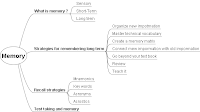
Memory is the process of storing and retrieving information. You will have difficulty remembering what you read if you do not know the stages in the memory process, and purposely use strategies at each stage to ensure that newly learned information becomes permanently stored. The single most important aspect of memory is understanding what you are trying to remember. It is difficult, if not impossible, to remember concepts you do not understanding.

The three primary stages in the memory process are sensory, short- term memory, and long- term memory. Specific strategies you can use to enhance your sensory memory include the following: reading your text aloud, drawing pictures of the information you are learning, acting out a chapter in front of a mirror or an audience, visualizing information in your head, using your fingers to point to new words, and reading while riding an exercise bike. Chunking is an effective strategy for organizing and remembering new information so that it remains in your short- term memory long enough to transfer into your long- term memory. In order to permanently store new information you can use strategies such as organizing newly learned information, mastering difficult vocabulary, creating a memory matrix, connecting new information you already know, going beyond the textbook, reviewing, and teaching the new information to someone else. Recall techniques called mnemonics can help you retrieve information once it has been learned and stored properly. Some mnemonics introduced in this chapter are key words, acrostics, and acronyms.

CRCB Chapter 2 Developing Yout College Vocabulary


CRCB Chapter 2 Developing Your College Vocabulary
Summary

Vocabulary building is one of the most important reading strategies you can lean. By increasing your vocabulary, you increase your understanding of textbook information. You also increase your ability to speak and write well- to communicate effectively. A rich vocabulary allows you access to many types of reading material, while a limited one prevents you from fully understanding what you read. Increasing your word power not only enhances your academic ability but also increases your chances of getting the job of your choice when you graduate.

Although no one knows every word, or interrupts reading to look up every unfamiliar word in the dictionary, using the simple strategies presented in this chapter will help you figure out and remember the meaning of new words. These strategies include using context clues, word analysis, writing in your textbook, creating word maps, understanding denotation and connotation, journal writing, and the card review system (CRS). Don’t skim over words you don’t know. It prevents you from really understanding what you read, makes it difficult for you to participate in class discussions, and can hurt you on exams.

An important way to make new word a part of your regular vocabulary is to use them in your everyday speech and writing in your journal daily will help.

CRCB Chapter 1 Reading in college


CRCB Chapter 1 Reading in college
Chapter Summary

Reading is an active process based on an author’s ability to convey meaning through the written word and your ability to extract meaning from those words. One way to read actively is to connect what you already know to the new information you are learning. Active learners become involved in their learning experience by previewing their reading assignments, outlining chapter or lecture notes, creating visuals, and reading books, other than their textbooks, to learn more about the subject they are studying.

Keeping a learning journal is also an active learning task. It helps you identify what you understand in a reading assignment and what is still unclear. It can also help you to understand how you learn, which learning styles work best for you, how you can improve those with which you have difficulty. Using a learning journal will help you to identify, analyze, and correct reading and learning difficulties.

Concentration involves purposely focusing your attention on a task while simultaneously blocking out distractions. The first step in achieving this is to learn what internal and external distracters block your concentration. The step is to record your concentration habits in your reading journal. By using this information, you can learn to change your study environment and state of mind so that you can read and learn effectively.